

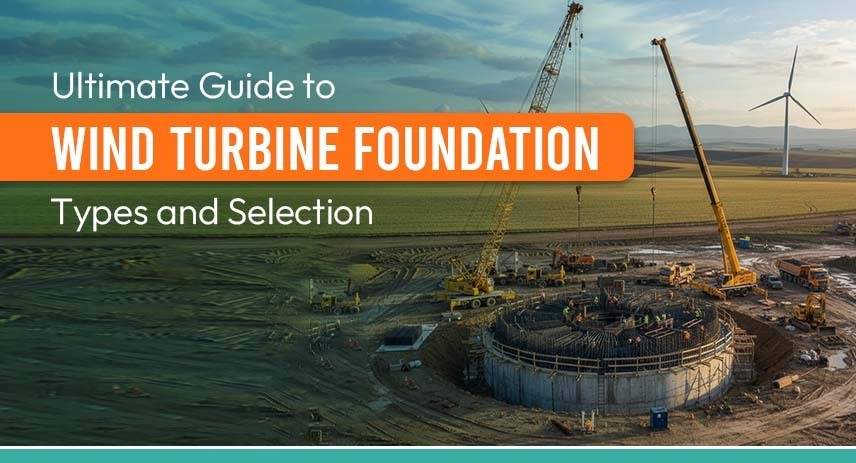
Ultimate Guide to Wind Turbine Foundation Types and Selection
Summary
This blog serves as a technical yet practical reference on wind turbine foundation types, written for developers, EPC contractors, and renewable energy stakeholders. It explains how foundation selection directly impacts structural safety, project cost, timelines, and long-term energy output. With a sustainability-first mindset, the content connects engineering decisions to carbon reduction goals and scalable wind energy deployment.
Wind energy projects succeed or fail long before the turbine rises above the skyline. One of the most decisive factors is the wind turbine foundation, the structural interface between the turbine and the earth. Selecting the right foundation type is not just a civil engineering decision; it is a strategic call that affects project economics, grid reliability, environmental impact, and asset life.
At Sangreen Renewables, wind projects are approached with a full-lifecycle lens balancing proven engineering practices with future-ready sustainability goals. This guide distills industry experience, field data, and execution insights to help stakeholders make informed foundation choices.
Table of Contents
- 1. Why Wind Turbine Foundations Matter
- 2. Key Design Parameters Influencing Foundation Selection
- 3. Major Wind Turbine Foundation Types
- 4.Technical Comparison Table: Foundation Types
- 5.Foundation Selection Workflow (Expert Approach)
- 6. Integration with Wind Project Services
- 7. Sustainability & Carbon Reduction Perspective
- 8. Market Demand & Foundation Trends Toward 2026
- 9. Common Design Challenges and Mitigation Strategies
- 10. FAQs on Wind Turbine Foundation Types
1.Why Wind Turbine Foundations Matter
Wind turbines are subjected to complex loads, static weight, cyclic wind forces, rotor-induced vibrations, and extreme events such as gusts or seismic activity.
The foundation must:
- Transfer loads safely to the soil or rock strata
- Control settlement and tilt over a 20-30 year lifespan
- Resist fatigue caused by continuous dynamic loading
A poorly selected foundation can lead to misalignment, power loss, premature maintenance, or structural failure. From a commercial standpoint, foundations can account for 15 – 25% of total project cost, making early-stage technical decisions critical.
2. Key Design Parameters Influencing Foundation Selection
Foundation design is site-specific. Experienced wind engineers evaluate the following parameters before finalization:
- Soil Bearing Capacity & Stratigraphy – clay, sand, rock depth, liquefaction risk
- Turbine Rating & Hub Height – higher towers impose larger overturning moments
- Wind Class & Turbulence Intensity – affects fatigue design
- Water Table & Drainage Conditions
- Seismic Zone & Extreme Load Cases
- Construction Access & Logistics Constraints
- Environmental and Land Permitting Conditions

3. Major Wind Turbine Foundation Types
3.1 Gravity Foundation
Overview: Gravity foundations rely on self-weight and large base area to resist overturning forces. They are typically constructed using reinforced concrete.

Best Suited For:
- Shallow, high-bearing-capacity soils
- Onshore wind farms with ample land availability
Technical Characteristics:
- Large excavation footprint
- High concrete and rebar consumption
- Proven performance history in onshore projects
Industry Insight: Gravity foundations remain the backbone of traditional wind farms due to predictable behavior and ease of construction using local resources.
3.2 Pile Foundation (Driven or Bored Piles)

Overview: Pile foundations transfer loads to deeper, stronger soil layers through friction and end-bearing.
Best Suited For:
- Weak or layered soil profiles
- High-capacity turbines (>3 MW)
Technical Characteristics:
- Steel or reinforced concrete piles
- Reduced excavation volume
- Requires specialized piling equipment

Execution Note: Accurate pile load testing and dynamic analysis are essential to control settlement and resonance effects.
3.3 Rock-Anchored Foundation

Overview: This foundation uses post-tensioned anchors drilled into bedrock, minimizing concrete volume.
Best Suited For:
- Sites with shallow rock strata
- Hilly or rocky terrains
Technical Characteristics:
- Compact foundation footprint
- Lower material usage
- Requires precision drilling and anchoring
Sustainability Angle: Reduced concrete usage directly lowers embodied carbon emissions.
3.4 Suction Bucket Foundation (Emerging Technology)

Overview: A steel bucket installed by creating suction pressure, primarily used in offshore but now piloted for nearshore and hybrid applications.
Best Suited For:
- Soft marine or coastal soils
- Projects prioritizing rapid installation
Technical Characteristics:
- Reversible and reusable
- Minimal seabed disturbance
- High upfront engineering effort
4. Technical Comparison Table: Wind Turbine Foundation Types

Foundation Type | Soil Condition | Construction Complexity | Material Usage | Cost Efficiency | Sustainability Score |
Gravity | Strong/Shallow | Medium | High | Medium | Medium |
Pile | Weak/Deep | High | Medium | Medium–High | Medium |
Rock-Anchored | Rock | High | Low | High | High |
Suction Bucket | Soft/Marine | Very High | Low | Emerging | Very High |
5. Foundation Selection Workflow
A structured selection process improves predictability and cost control:
- Detailed geotechnical investigation
- Preliminary foundation sizing and load modeling
- Life-cycle cost and constructability review
- Environmental and permitting alignment
- Final design optimization and value engineering
This workflow integrates seamlessly with Project Management and Civil BOP execution strategies.
6. Integration with Wind Project Services
Foundation engineering does not operate in isolation. It aligns closely with:
- Project Management – Schedule, cost, and risk coordination
- Land Permits & Approvals – Soil use, excavation permissions
- Civil BOP – Excavation, concreting, anchoring works
- Mechanical & Electrical BOP – Load transfer interfaces
- Logistics – Transport of reinforcement cages, piles, and steel components
7. Sustainability & Carbon Reduction Perspective
Foundation optimization is a quiet but powerful lever in reducing carbon emissions. Efficient designs:
- Reduce concrete volume and steel usage
- Minimize land disturbance
- Enable faster commissioning and earlier green power generation
Every optimized foundation supports the broader mission of delivering clean, reliable wind energy at scale.
8. Market Demand & Foundation Trends Toward 2026
Looking ahead to 2026, industry trends indicate:
- Taller towers driving higher foundation loads
- Increased adoption of hybrid and low-carbon foundations
- Greater use of digital soil modeling and structural simulation
- Strong demand for cost-optimized onshore wind in emerging markets
Foundations are shifting from conservative oversizing to precision-engineered solutions.
9. Common Design Challenges and Mitigation Strategies
- Differential Settlement: mitigated through soil improvement and pile optimization
- Fatigue Cracking: controlled via dynamic load modeling
- Water Ingress: addressed with drainage layers and waterproofing systems
Experienced execution teams reduce these risks early in the design phase.
10. FAQs on Wind Turbine Foundation Types
Q1. Which foundation type is most common for onshore wind turbines?
A. Gravity foundations remain the most widely used due to simplicity and proven performance.
Q2. How does soil testing impact foundation cost?
A. Accurate soil data prevents overdesign and unexpected construction delays.
Q3. Are low-carbon foundations commercially viable?
A. Yes. Optimized designs and alternative materials are increasingly cost-competitive.
Q4. How long does foundation construction typically take?
A. Depending on type, 2–6 weeks per turbine including curing and backfilling.
Final Note
Wind turbine foundations are more than concrete and steel; they are the physical commitment to a cleaner energy future. Strategic foundation selection strengthens project viability, reduces emissions, and supports the global transition toward sustainable power generation.